Bringing a puppy home is a very different experience, and the dog vaccination schedule will carry forward this experience for a long time. When you adopt a puppy, their soft paws will change your entire home. However, if you are newly married or you don’t have a baby, adopting a puppy would be a good parenting experience for you, but one thing you should keep in mind is that during the first few months of life, a puppy is highly susceptible to infectious diseases that can be dangerous or deadly.
Vaccinations are the backbone of preventative veterinary medicine. They don’t just protect your dog; they protect the entire dog community to make their immunity strong. In this guide, we will give you the knowledge of “why, “when, and “what” of puppy vaccinations, giving you a roadmap to follow your pup’s first year of health.
Why Dog Vaccination Schedule Important
When puppies are born, their immunity is not permanent; they build temporary immunity from their mother’s milk. Mother’s milk gives them antibodies, which are important for their body. These antibodies are strong, but they are not permanent, and they can actually interfere with vaccines, which is why dog vaccination schedule is important.
If we gave a puppy a single shot at six to seven weeks old, the maternal antibodies might “square up” the vaccine before the puppy’s own immune system can learn from it. This is why veterinarians always administer booster doses every 3 to 4 weeks. When the puppy has been growing, the mother’s milk antibodies naturally fade because the vaccine takes over, but the dog vaccination schedule helps their body to boost antibodies.
The Core vs. Non-Core Vaccines
- Core Vaccines
These vaccines are mandatory for all dogs, regardless of breed. These vaccines protect our dog against diseases that are globally disastrous, highly contagious, and have a high mortality rate.
- Parvovirus: It’s a highly contagious virus that causes severe bloody diarrhea with continuous vomiting. If your puppy or dog gets infected with this disease, it can become fatal. This disease mostly catch your dog by Indie dog’s which are living in your streets.
- Rabies: It’s a lethal disease that can be transmitted from animals to humans. Rabies vaccination is required by law in every jurisdiction because of the public health risk.
- Canine Hepatitis: This viral infection is not like others; it affects your pet’s liver, kidneys, and lungs with mortal consequences.
- Canine Distemper: A severe virus that attacks the respiratory, nervous system, and gastrointestinal system.
2. Non-Core Vaccination: These vaccines are optional, but you should get them for your pet because they will protect your dog from other common diseases.
- Lyme Disease: You can get this vaccine if you live in a highly tick-prone population.
- Leptospirosis: It’s a bacterial infection that spreads through the urine of wildlife. It has the potential to damage your pet’s kidneys and liver, and can also be passed to humans.
- Canine Influenza: Similar to the human flu, this is advised for dogs that are constantly in social settings.
- Bordetella Bronchiseptica: It’s known as “Kennel Cough.” If your pet frequently goes to daycare, the groomer, or the park, you should get this vaccine during your dog vaccination schedule. It will be good for your pet.
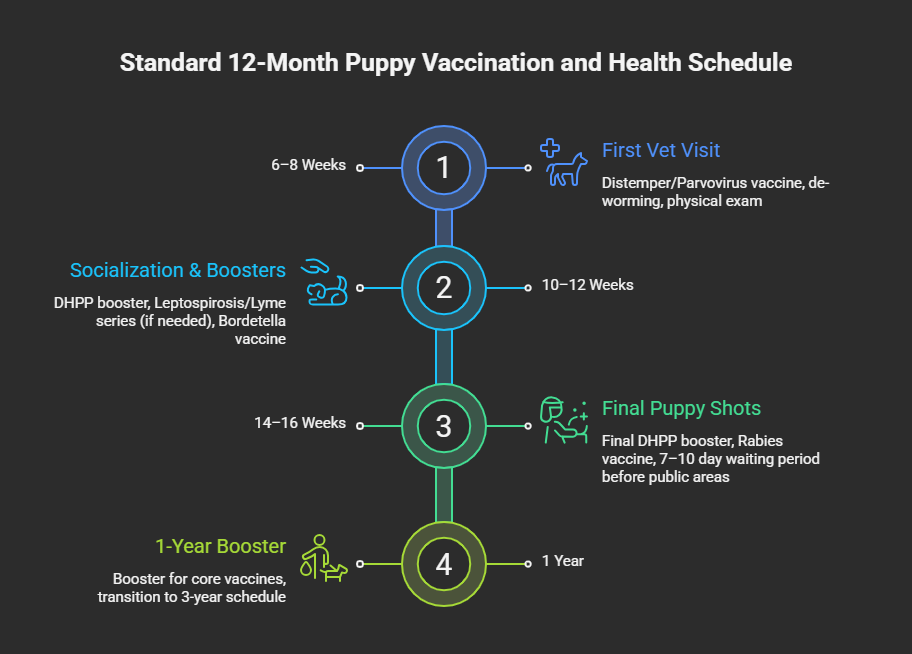
The 12-Month Dog Vaccination Schedule
Tips for a stress-free vet visit
- Keep High-Value Treats: If your puppy does not want to visit the vet, just bring some high-value treats with you. It can be pieces of boiled chicken, peanut butter, or egg whites. If your puppy loves a delicious snack, they will be happy to visit next time.
- Health Certificate: Do not forget to keep a digital copy of your pet’s certificate on your phone. You will need it for training classes and other appointments, and when you visit your veterinarian during your dog vaccination schedule, tell them to note everything about your dog on their card.
- Ask Questions Freely: If you do not know about vaccines, lifestyle, or other stuff, you should have a quality chat with your vet so you can be tension-free.
Conclusion
Your puppy’s first year is not a sprint race; it’s a real marathon of learning and growth. You have to be strict with your dog vaccination schedule. If you give your quality time to build the foundation of your puppy, it will support them for the next 10 to 15 years.